MS thesis · Arizona State University · 2024
Soft Body Armor Impact Modeling
A finite element framework for ballistic impact in multilayer soft armor.
Research question
Can a solid-element model reproduce both projectile penetration through the armor pack and the deformation left in the clay backing? The project evaluated backface signature (BFS), penetrated layers, and qualitative damage patterns against ballistic test observations.
Model and method
The LS-DYNA assembly included a .44 Magnum projectile, 14-layer shoot pack, elastic straps, and clay backing. Solid elements represented the shoot pack so its through-thickness shear and punch-shear damage could be resolved. The shoot-pack constitutive law used MAT_213; a transversely isotropic assumption reduced the number of independent material parameters considered. A parameter study varied uncertain out-of-plane strengths, followed by local mesh refinement of the shoot pack and clay.
Results
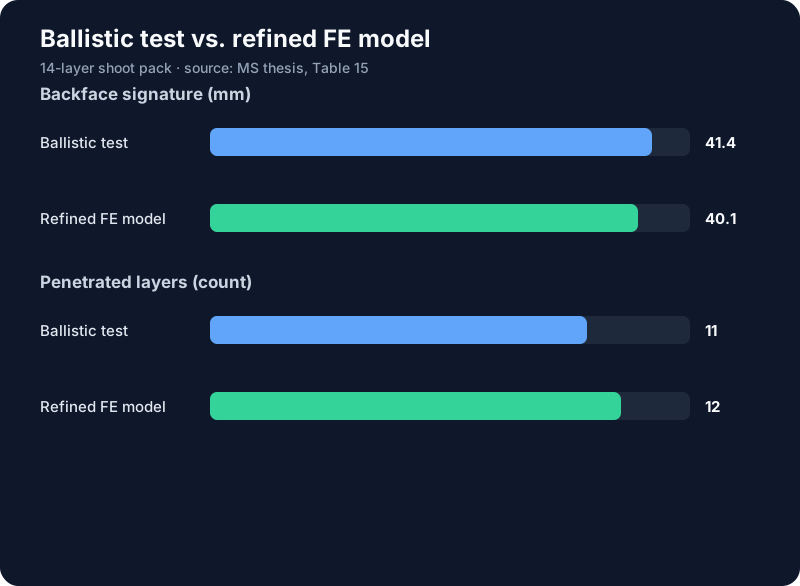
For the referenced ballistic shot, the test measured 41.4 mm BFS and 11 penetrated layers. The preliminary model predicted 38.3 mm and 12 layers. After mesh refinement and parameter calibration, the model predicted 40.1 mm and 12 layers. The refined shoot-pack mesh increased from 45,934 to 215,418 solid elements, while the clay mesh increased from 125,000 to 317,900 solid elements.
Interpretation and limits
The refined model improved agreement for the two reported quantitative targets and reproduced aspects of the strike-face hole. It still overpredicted penetration by one layer and did not accurately reproduce the eroded layer at the clay interface. The thesis describes a calibration against limited ballistic test data; broader validation would require additional shots and materials.
Source and contribution
Based on my 2024 MS thesis, “A Framework for Soft Body Armor Design Using Solid Finite Elements,” completed at Arizona State University under Subramaniam Rajan. The thesis builds on earlier ASU modeling work. The numerical comparisons above are from Tables 13–16 and the discussion in Chapter 6.